
From Gerd Kommer and Luca Stagnitti
Few other topics have generated as many financial media headlines in the last 24 months as artificial intelligence (“AI”). From a private investor perspective, the two main questions that arise about AI are: “Will AI be a game changer in investing?” and, if so, “how will AI change the laws of investing?”
In our opinion, if you want to find convincing answers to these questions, you have to sort out some fundamental aspects surrounding the “wild” topic of AI. Once you've done that, the answer to the "game changer" question almost falls into your lap.
Is AI new?
No, AI has existed for over 60 years. AI as a real economic phenomenon and not just an idea in literature probably had its origins in the groundbreaking essay “Computing Machinery and Intelligence” by the British IT genius Alan Turing in 1950. The American IT engineer John McCarthy coined the term in 1954 Artificial Intelligence (AI). [1] Afterwards, there were also other names for what is now called AI or AI (Artificial Intelligence), for example “expert systems”, “neural networks”, “large language systems”, “deep learning” and “machine learning”. [2] The article “History of artificial intelligence” in the English Wikipedia (here) provides information about the not-so-short history of AI.
So AI is not new. AI seems new to us primarily because of the launch of the AI chatbot, which is free in the basic version ChatGPT In November 2022, AI catapulted into the general public's awareness for the first time.
How strong will the transformative effect of AI be on the real economy?
The “transformational effect” means a structural increase in global economic growth and therefore also in private household income through AI. Some AI enthusiasts and (would-be) experts on “disruptive technologies”, “AI singularity” and “tech as a megatrend” believe it is possible that AI will transform humanity into a new economic one Shangri-La will lead.
In our opinion, this will not happen. AI may “only” help to partially offset the negative growth effects that result from demographic developments and the costs of combating climate change - in Germany also from the ever-increasing obstacles to growth that our governments are responsible for. This type of economic growth support through AI would be enormously valuable if it actually happened, but it is far from the exaggerated thesis “AI will significantly increase global economic growth in the next ten years” or “AI will accelerate the economic growth of those countries that embrace AI in their economic policy”.
Why are we so skeptical? Since the beginning of the Industrial Revolution around 1770 and before, there have been countless technological innovations that, in retrospect, were indeed transformative for human existence, but yet in themselves did not trigger a measurable increase in economic growth. Consider, for example, the printing press, the steam engine, electricity, railways, the automobile, artificial fertilizers, concrete, telegraphy and telephony, airplanes, antibiotics, computers, the Internet and many other revolutionary innovations that dramatically improved our economic existence and increased the life expectancy of the average person on this planet two and a half times since the mid-19th century (see the "Timeline of historic inventions" here, for the increase in life expectancy over the last 250 years see here).
Which two approaches to AI must be distinguished when investing?
From a practical investor perspective, one can differentiate between: (a) investing in companies that make money with products and services related to AI (investing in “AI-related companies”) and (b) investing with AI support (“AI-driven investing”). These are two fundamentally different ways to use AI in investment.
First, an assessment of path (a), funds, with an investment focus on AI-related companies: At the end of May 2024, six passive equity-themed ETFs that replicate AI indices were offered on the German ETF market. Two were still very new and therefore did not have a meaningfully interpretable return history. Four had a history of between four and a half and five and a half years (WKNs A2JSC9, A2N7KX, A2N6LC, A2PM50). All four of these ETFs significantly underperformed broader diversified general US tech ETFs or global tech ETFs (e.g. WKNs A0YHMJ, A14QB5, LYX0GP) in the four and a half years ending May 2024.
In the larger US ETF market, at the time of our recent database query, there were eleven actively and passively managed (index-based) AI ETFs with at least a five-year track record and the term “Artificial Intelligence” or “AI” in their names. For the five years ended May 31, 2024, the average return of these eleven AI ETFs was 8.4% p.a. (in USD) compared to an ETF on the general US tech index Dow Jones US Technology Index with a return of 24.9% p.a.
The numbers for AI ETFs sold in Germany and the USA do not indicate that investing in AI-related companies represents a “game changer” – rather the opposite.
Yes, there are some “AI companies” with extremely high stock returns over the past two, three years and in some cases longer. NVIDIA is the most famous among them. However, these few outlier values are typically only weighted between three and ten percent in an actively or passively managed “AI fund” for regulatory or risk management reasons.
Now to path (b), general investing supported by AI tools and techniques (supposedly or actually “AI-driven funds”). The Eurekahedge AI Hedge Fund Index (Bloomberg ticker EHFI817) is an index that tracks actively managed hedge funds that use AI techniques in their official investment strategy - either to make trading processes more effective or to directly help with investment decisions. This type of AI use in the financial industry has been happening for well over 20 years, so it is not new either. In the table below we compare the return and risk of this index to two simple passive benchmarks.
Table: Comparing performance of AI hedge funds with a broad equity index and a passive 30/70 equity-bond portfolio - in USD, nominal, from May 2019 to April 2024 (5.0 years)
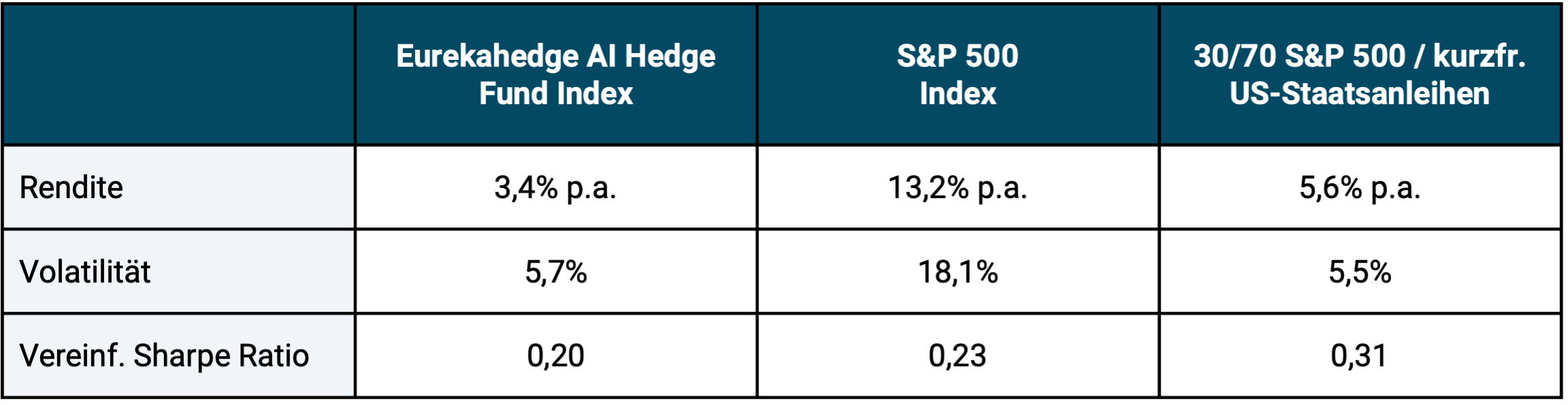
► Without taxes. ► Costs have already been deducted for the hedge fund index, but not yet for the two passive benchmarks (these would be relatively modest at around 0.3 percentage points annually). ► Volatility: Annualized standard deviation of monthly returns. ► Simplified Sharpe Ratio: Arithmetic average return ÷ volatility. ► Data sources: Eureka, Dimensional Fund Advisors.
The numbers in the table speak for themselves so clearly that they require no further explanation.
How did it look? before this five year period? The Eurekahedge AI Hedge Fund Index dates back to January 2010. In fact, it produced an exorbitant outperformance compared to the two benchmark portfolios shown in the table in the first 21 months to September 2011, but has been trending further and further behind passive low-cost alternatives on a buy-and-hold basis for over twelve years. It therefore seems plausible that the application of AI for investment purposes in an early or start-up phase did indeed generate risk-weighted excess returns (“alpha”), but this golden age of AI investing is now a long time ago. It looks like the AI effect has been priced in for a long time.
We are also not aware of any actively managed, AI-controlled mutual funds (UCITS funds) in Germany that have outperformed a global ETF tech benchmark (e.g. an MSCI World IT ETF) in the last three years. We checked this specifically for the ten largest such active funds in terms of investment volume.
Some scientists also came to sobering results about the success, or rather lack of success, of investing with AI support in a study published in 2021 in which they evaluated the academic literature on this topic. [3]
What is the economic logic behind the disappointing AI investment returns?
In our view, the unimpressive empirical results for AI-oriented investing in stocks that we have summarized above are not a coincidence, but rather the inevitable result of an economic logic that looks like this:
Yes, the early or earliest developers and adopters of a new technology can be very financially attractive to its owners (shareholders in the case of listed companies) if the technology proves to be commercially successful. If not, the early investors in these first movers may burn a lot of money.
If successful, the market will very quickly recognize the attractiveness of the initial phase and “estimate” it in the share prices of the companies in question. And in the case of listed companies, this is almost always too fast and too early for 95% of those who spend time and money looking for such opportunities, whether they are Cathie Woods, Frank Thelen, Jan Beckers, Hendrik Leber or Lieschen Müller. Who after Buying this price comes too late. He is doing an average or even a bad deal. The rapid pricing of new information in the capital market is famous Information efficiency of the capital market, usually shortened and latently misleading Market efficiency called.
When it comes to the “AI stock market,” this pricing happened a long time ago. The world's most famous AI-related company, NVIDIA, had a price-to-earnings (P/E) ratio of 68 at the end of May 2024 (Trailing) and 42 (Forward). These are stratospheric valuation levels that, looking forward, will only not end in investor disappointment if and as long as (a) no competitor manages to capture a significant portion of NVIDIA's high sales and high margins in the relevant AI microchip technologies and/or (b) if demand for these high-priced microchips remains as extraordinarily high as before. But we all know: At some point, every innovative, rapidly growing market shows signs of saturation or falling margins. We most recently saw this with electric cars, in which the original boom in corporate profits and stock returns ended “surprisingly” at the beginning of 2024 after around five years of hype. The index fund developer and academic financial economist Robert Arnott recently described the current situation of AI from an investor perspective as follows: "Yes, AI is transformational. It's path-breaking. And I think it's a bubble."
Another relevant fact becomes apparent when one looks away from the stock market and towards the real economy. In this context, the majority of the economic benefits of inventions and other innovations generally do not benefit the originator of the innovation (as one might intuitively assume), but rather all or at least many sectors. Market economy competition ensures this and the state also partly ensures this with its anti-monopoly policy. The well-known venture capitalist and billionaire Marc Andreessen once expressed it like this: "Creators of technology are only able to capture about two percent of the economic value created by that technology. The other 98 percent flow through to society in the form of what economists call social surplus." [4]
AI may change the world, but not the world of investing
If you look at what clever minds have written in the past about the basic character of capital markets, you will come to the conclusion that financial markets are, first of all, “information processing machines” - social organizations that quickly collect and integrate the decentralized information and knowledge of millions of people and institutions about individual stock market investments in a fascinating way and thereby motivate buying and selling transactions - all of this, by the way, completely without government planning. In this process, which is extremely important for the wealth creation of an individual household and the capital allocation process of entire economies, people have always used tools since organized capital markets emerged over 300 years ago. And because Homo sapiens Being what he is, he has continuously improved these tools over time. One such tool today is AI. To the extent that AI actually delivers useful output, it will further accelerate the information processing power of the market and thus it more information efficient do more than he already has. One researcher put the matter this way: "Material information gleaned from running AI processes is very likely a subset of the vast information set known by the market in aggregate and reflected in market prices. If new information is obtained, the process of acting on that information (buying or selling stocks/bonds) incorporates it into market prices. As more investors employ these tools, any edge from doing so should wane." (Wes Crill, Dimensional Fund Advisors, May 18, 2023). [5]
In this sense, the use of better AI tools than in the past does not change the central structural element of securities markets, their high information efficiency.
A special aspect of information processing in the capital markets is the recognition and use of patterns. In the pre-AI era, people looked for sufficiently stable patterns in historical data and then competed with each other with their predictions derived from these data and patterns. The competition was called “Who is the best and most profitable over a sufficiently long period of time, taking into account costs, taxes and risk?” Pattern recognizer?“.
Well, in the “new” era of AI (which actually started at least 20 years ago), people are searching and AI systems work together according to stable, exploitable patterns in historical data and then compete with each other - just as before. Structurally, nothing has actually changed, except that the feedback process between actors and the market (the pricing of new information) has accelerated again through the addition of AI.
To the extent that one follows this logic, one must almost inevitably come to the conclusion that the widespread adoption of AI will make it not easier, but rather even more difficult, for active investors - including those who use AI themselves - to beat the market (including all other AI users) in the future, i.e. to achieve systematically higher returns than with a comparable passive buy-and-hold investment, when costs, taxes and risk are taken into account.
Since you cannot get patent protection for investment strategies - including AI-supported strategies - and these types of trade secrets are generally not easy to protect, successful investors were quickly imitated, which quickly destroyed their advantage and outperformance.
The fact that employees of a successful institutional investor can quit at any time and hire a competitor “for more money” also ensures that superior knowledge is constantly diffused into the market.
Looking forward, we believe there will be few successful AI-related investment strategies. These few will be heavy ex ante to be identified and, moreover, predominantly have a short life expectancy. Most of us who spend time and money looking for these positive outliers will end up rubbing our eyes in frustration as we evaluate our risk-return balance.
Mind you, all of this contradicts neither the possibility that AI will significantly change and hopefully improve our individual existence, nor the prospect that, after taking into account the other growth-stopping factors mentioned at the beginning, AI will make a moderately positive contribution to global economic growth and thus to all of our existence. Headlines currently appearing in the media such as “AI is changing the course of world history” and similar statements with great pathos and clearly audible gasps are almost certainly exaggerated clickbait.
However, the weak prospect of achieving attractive returns with AI-oriented investing will not stop a legion of financial industry representatives, business journalists and “finfluencers” from continuing to spread the fairy tale of “AI as an investment game changer” because they directly or indirectly profit from this spread.
Conclusion
AI will possibly noticeably change our subjective existence in the next few years and – it is to be hoped – bring about at least a moderate overall increase in trend economic growth. In the world of investing, AI will further increase the “beating the market hurdle” – i.e. outperforming a technically correctly chosen passive benchmark in terms of costs, taxes and risk over a non-trivially short period of time.
Endnotes
[1] Hollywood produced the exciting biopic in 2014 The Imitation Game about Alan Turing. The first literary processing of the idea of artificial intelligence was possibly the fairy tale “The Sandman” (1816) by the German writer E.T.A. Hoffmann (1776 – 1822) and about 60 years later the novel “Ewhon or, Over the Range” (1872) by the Briton Samuel Butler (1835 – 1902).
[2] In this context, it is irrelevant that these older or alternative names may not be 100% congruent with the current interpretation of the term “artificial intelligence”.
[3] Buczynski, Wojtek et al.: “A review of machine learning experiments in equity investment decision-making: why most published research findings do not live up to their promise in real life”; In: International Journal of Data Science and Analytics; 11; 2021.
[4] "The creators of a technology only receive around two percent of the economic value that this technology creates. The other 98 percent flows to society in the form of economic added value."
[5] "Significant information produced in AI processes is most likely a subset of the information known to the aggregate market and [already] reflected in market prices. After receiving new information, the process of acting on that information (buying and selling stocks and bonds) will incorporate that information into market prices. As more investors use AI tools, any benefits from those tools are likely to disappear."