

<<< This blog post is also available as a YouTube video. >>>
From Alexander Weis and Gerd Kommer
This post was updated in March 2026.
“Nothing about currencies is simple.” Mark Kritzman, American financial economist and fund manager
Anyone thinking about exchange rate hedging in a globally diversified ETF portfolio should first be clear about some of the central aspects of this challenging topic. Although these partial aspects overlap and influence each other, they are independent aspects within the fundamental question Exchange rate hedging: yes or no? We address these nine aspects one after the other and thus arrive at a general assessment of the advantages and disadvantages of currency hedging. The partial aspects are:
(a) The definition of currency risk (exchange rate risk)
(b) The concept of “functional currency”
(c) The concept of “Fund Currency” or “Reporting Currency”
(d) The cost of exchange rate hedging
(e) What is a “dollar-denominated asset” or a “USD asset”?
(f) The distinction between supposed and actual currency risk in the portfolio
(g) The different relevance of exchange rate hedging in the equity and bond parts of a portfolio
(h) In which asset classes exchange rate hedging makes sense and in which it does not
(i) A depreciating home currency has both advantages and disadvantages for the investor
Let's start with (a), the definition of currency risk.
(a) The definition of currency risk (exchange rate risk)
Currency risk for a particular investor is the risk that currency A (which we consider to be the investor's “functional currency” or “home currency”) will depreciate or appreciate relative to currency B during the relevant period and that this change will have an adverse effect on the investor's investment return, measured in its functional currency A.
Typically, an exchange rate risk is also offset by a symmetrical exchange rate opportunity.
In this context, a fundamental insight from financial market research should first be noted: Hardly anything is more difficult to predict correctly than the short and medium-term development of exchange rates, because foreign exchange markets are probably the most “informationally efficient” financial markets of all. In such markets it is de facto impossible to achieve a systematic (i.e. not just temporary and random) advantage over a forecast-free buy-and-hold approach using publicly available information about costs, taxes and risk. Therefore, if you rely on the exchange rate forecasts of “experts” in the media or banks, you might as well ask Esmeralda and her tarot cards (see the following info box on interest rate parity theory).
Infobox: The interest rate parity theory
The fundamental question about the causes of the appreciation or devaluation of a currency A against a currency B in a free foreign exchange market can be answered with the interest rate parity theory: According to this (empirically confirmed) logic, currencies of countries with high nominal interest rates tend to depreciate compared to currencies of countries with low nominal interest rates. Currencies with high nominal interest rates tend to be currencies in which the inflation rate is also high.
How and why does the mechanism work? If this exchange rate trend did not exist, an investor could generate risk-free profits (arbitrage profits) by using so-called currency futures. At a given point in time, there will therefore tend to be just as many of these currency futures for the risk-free exploitation of the interest rate difference that in the future the high-interest currency A will be sold more and the low-interest currency B will be bought more frequently. A will therefore tend to depreciate against B in the future and tend to depreciate so much that interest-bearing investments in the foreign currency are not statistically worthwhile.
In addition to the interest rate level, however, a variety of other factors influence exchange rate changes (e.g. changes in the balance of payments, trade balance, capital account, inflation, political risk) and in a specific case it will not be possible to conclusively answer why a currency has appreciated or devalued to a specific extent compared to another currency.
(b) The concept of functional currency
Now to (b), the “functional currency” of a private household. It is the currency in which most or all of its payment obligations (its expenses or cash outflows) will be “denominated” in the future. You could also simply say: the “home currency” of the household. For a typical household living in Germany, this is the euro; for a household in Switzerland, the Swiss franc. The concept of the functional currency is banal in itself, but its thorough understanding is the basic prerequisite for truly understanding where there is exchange rate risk and where there is not.
Two The following family of four living in Konstanz on Lake Constance (very close to the Swiss border) has functional currencies: One working spouse (the one with the larger salary income) is a cross-border commuter and works in nearby Schaffhausen (Switzerland). He receives his salary in Swiss francs. The other spouse works in Konstanz and receives a salary in euros. The family took out a Swiss franc loan for their home in Konstanz because their main income is denominated in CHF. Most of the other spending on consumption takes place in Germany, i.e. in euros. In this non-standard household, the functional currencies could be the euro and the Swiss franc, for example. B. be divided in a ratio of 70/30.
(c) The concept of “Fund Currency” or “Reporting Currency”
The concept of “fund currency” or “reporting currency” of a portfolio has no per se relevance to an investor's foreign exchange risk in that portfolio or fund. This aspect of currency risk, particularly in actively managed or passively managed funds, is often misunderstood by financial journalists and private investors and occasionally even by professionals. Let's look at the example of an ETF on the MSCI World Standard Index. Such ETFs are offered in Germany with both the fund currency dollars and the fund currency euros. The exchange rate risk for a German private investor whose home currency is the euro is exactly the same in the case of such an ETF with the fund currency (reporting currency) euros as with an ETF with the fund currency/reporting currency dollars. The reporting currency is a (completely) arbitrarily chosen unit of account to express an economic substance that is independent of it.
Assume that the MSCI World Index returns 12% in USD in a given calendar year. In the same year, the euro appreciates against the USD by 5% and the USD depreciates against the euro by 5%. Investors Valentin and Investor Carolina, who live in Austria (their functional currency is therefore the euro), have each invested in an MSCI World ETF. Valentin owns ETF A with the fund currency USD, Carolin owns ETF B with the fund currency Euro. How does this difference affect the returns in euros achieved by Valentin and Carolina? For ETF A, the “reported” return (the fund return) would be 12%, i.e. the return in USD. However, Valentin and Carolina both calculate in euros - this is the only return that matters to them at the end of the day. “Kindly” Valentin’s custodian bank converts the USD return from ETF A into euros in the monthly portfolio report and in euros it is 7%. For the otherwise identical ETF B from Carolina with the fund currency euro, the reported return is 7% from the start because the fund company has already carried out the conversion, so the custodian bank no longer has to do it.
Ergo: The specific reporting currency of a fund, the fund currency, is completely economically meaningless. For the real Currency risk in a specific functional currency depends only on the economic substance, which is of course identical in both ETFs - after all, they replicate the same index. The fact that multiple funds are offered for the same index that have different fund currencies (common with MSCI World ETFs and S&P 500 ETFs) is an irrelevant marketing gimmick that suggests to investors that there is a non-existent difference in risk.
(d) The cost of exchange rate hedging
Now to aspect (d), the costs. Exchange rate hedging is not free. The cost of exchange rate hedging will tend to be higher (a) the longer the period of currency hedging and (b) the more “exotic” the currency pair being hedged (the USD-Euro exchange rate is an example of a non-exotic currency pair). Short-term hedging between major currencies (mainly the dollar, euro, pound and yen) is the cheapest and almost free for institutional investors. If many individual cheap, short-term hedges are strung together for years, the cumulative costs can still add up to a considerable amount.
An example: Currency-hedged ETFs on the MSCI World Standard Index currently have additional costs compared to the unhedged ETF variant in the form of a higher “total expense ratio” (the “ongoing costs” in the fund fact sheet) of around 0.3%. But this not insignificant difference only includes a part, perhaps even a smaller part, of the total hedging costs. A significant portion will be hidden in the ETF's return. This can be easily demonstrated by comparing two ETFs on the same index for periods of 5+ years, only one of which has a currency hedge. In the very long term, the latter will usually underperform the former to a greater extent than can be explained by the higher running costs.
Hedging costs are generally higher for private investors than for institutional investors. For private investors who do currency hedging “manually” on their own, these costs are likely to be significantly higher than for institutional investors, even for the main currencies. The amount of work that this entails for private individuals is very high in the long term and is probably hardly bearable for a normal private investor.
(e) What is a “dollar-denominated asset” or a “USD asset”?
Many “experts” refer to e.g. B. Gold, Bitcoin or an S&P 500 ETF as “USD assets”? They want to express that the level of returns on these three assets and the fluctuations in returns (the risk) in a given period are significantly and systematically influenced by the exchange rate of the dollar to other currencies. In reality, this view is nonsense for all three assets mentioned. Rather, these are “global assets”, not USA assets or USD assets. The return and risk of global assets are not causally linked to any specific currency. The fact that the returns on gold, Bitcoin and the S&P 500 are typically quoted in USD does not change this fact. Even the fact that the real returns on such an investment will differ over a given period does not prove that the exchange rate development is the cause of this delta.
Global assets can (also) be recognized as such by the fact that the volatility of their returns over longer time frames in different currencies is very close to one another. Their inflation-adjusted returns in different currencies also differ little over longer periods, and when they do, the difference is unsystematic, so will probably look different again in the next period.
(f) The distinction between supposed and actual currency risk in the portfolio
Now let's move on to the most important consideration in this article, the distinction between perceived and actual currency risk in a globally diversified equity portfolio. Of course, there is exchange rate risk for an international stock investor (which in most cases is a risk anyway and opportunity at the same time). However, this exchange rate risk is different than what some private investors imagine and its real (rather than just apparent) hedging in a globally diversified equity portfolio may be impossible in practice.
This should be made clear using an example: Private investor Philipp with the functional currency (home currency) euro has completely invested the risky part of his ETF portfolio in an ETF that replicates the MSCI World Standard Index. This index represents over 1,000 companies from probably 50+ different developed countries and have their primary stock exchange listing in 23 developed countries. The 23 stock exchange listing countries have a total of 13 different currencies. The largest single position in the MSCI World at the end of 2017 was the share of Apple Inc. Apple sells its products in around 150 different countries and thus generates revenue in many dozens of currency areas. Apple's spending also takes place in over a hundred different currency areas. (According to Wikipedia, there are 180 currencies worldwide.)
The US dollar area is certainly the most economically important for Apple, but it is certainly not the only decisive factor. The same applies to almost every one of the over 1,000 companies in the index, whose average market capitalization is just under ten billion dollars (median value). So they are not small businesses whose entire business takes place domestically. The profits and cash flows of none of these 1,000 companies depend on just one currency, just like those of the elephant Apple. In the long term, no one can determine with reasonable effort what exactly these currency dependencies will look like in the entire portfolio of 1,000 stock companies over time.
In an even better globally diversified portfolio than the MSCI World Standard Index such as: B. in the “MSCI ACWI IMI” small cap stocks and emerging market stocks are also represented, so we have around 9,000 companies in basically over 190 countries (and over 45 after the primary stock exchange listing). If one assumes that only 20 currencies are somehow present in the economic substance of a globally diversified basket of stocks, this already results in 190 exchange rates that potentially influence returns, i.e. currency pairs. The formula for this is (n × (n – 1)) ÷ 2. If you assume 100 currencies, there are 4,950 exchange rates. In one sentence: Anyone who diversifies globally ultimately has hundreds or thousands of exchange rate risks and opportunities in their portfolio. The relationship between the USD and the investor's functional currency is just one of them. Hedging one or a few of these relationships (e.g. that between the functional currency and the USD) is ultimately pointless and perhaps even harmful. However, this is exactly what happens in currency-hedged international equity funds/ETFs, including USD funds, that invest in many global companies such as Apple (e.g. an S&P 500 ETF).
These exchange rate risks often behave differently than some people think. A study showed that the stock markets of so-called "soft currency countries", whose currencies depreciate in the long term compared to the hard currencies (Euro, USD, CHF, GBP, Yen), i.e. have a "chronic" devaluation tendency, tend to have stock returns that are just as high as the hard currency countries themselves, of course measured in hard currency (Dimson et al. 2006). This could have something to do with the additional risk in the soft currency countries. Returns are primarily risk compensation. As Table 1 shows below, the differences in returns of an international equity portfolio in real (inflation-adjusted) returns, as opposed to nominal returns, in different currencies are rather small in the long run.
Anyone who hedges the exchange rate between their functional currency and the USD or between their functional currency and the currencies corresponding to the headquarters of the companies in the portfolio in a globally diversified stock portfolio is actually entering into two separate transactions: an investment in a broadly diversified basket of stocks in which a de facto inextricably complex and time-changing mix of exchange rate effects operates, and a speculation that their home currency will appreciate against these ultimately arbitrarily selected currencies. This common form of exchange rate hedging of global equity portfolios has little to do with the economic substance of the currency effects in the portfolios.
The visual connection that is created for the investor by the balanced interaction of the “underlying transaction” and the additional, separate exchange rate bet on the functional currency, e.g. B. the EUR or the CHF, has no meaning for our question. The exchange rate bet is a separate random variable. This form of currency hedging in such a portfolio makes no sense from an ex-ante perspective (looking into the future) for the vast majority of private investors. In the long term, neither a reliable reduction in risk nor a reliable increase in returns can be achieved.
In addition, the volatility of stocks themselves is so high that the isolated reduction of the low and unsystematically correlated volatility of exchange rate risk in a diversified stock portfolio does not produce a significant difference in volatility. Even with the “purely American” S&P 500 index, the volatility in euros with a USD-Euro hedge or without a hedge is about the same over longer periods of time. Over short time frames, the variant with an exchange rate hedge in euros can be either more or less volatile.
Real Currency hedging, viz all relevant exchange rates is impossible and would be far too expensive if one even attempted it.
Of course, the long-term nominal returns of the world stock market measured in different currencies differ quite significantly in retrospect for specific time windows. This is illustrated in Table 1 below. But the z. The sometimes considerable differences in nominal returns in different currencies are irrelevant and anyone who takes it seriously - as some journalists and finfluencers do - shows that they have not fully understood the issue. The real returns are crucial and here the differences are very small, as Table 1 also shows. Also important. The remaining differences are unsystematic. If you were to measure over other time windows, different but probably small differences would emerge.
Table 1: Return of the MSCI World Standard Index from 1975 to 2022 (48 years) in different currencies
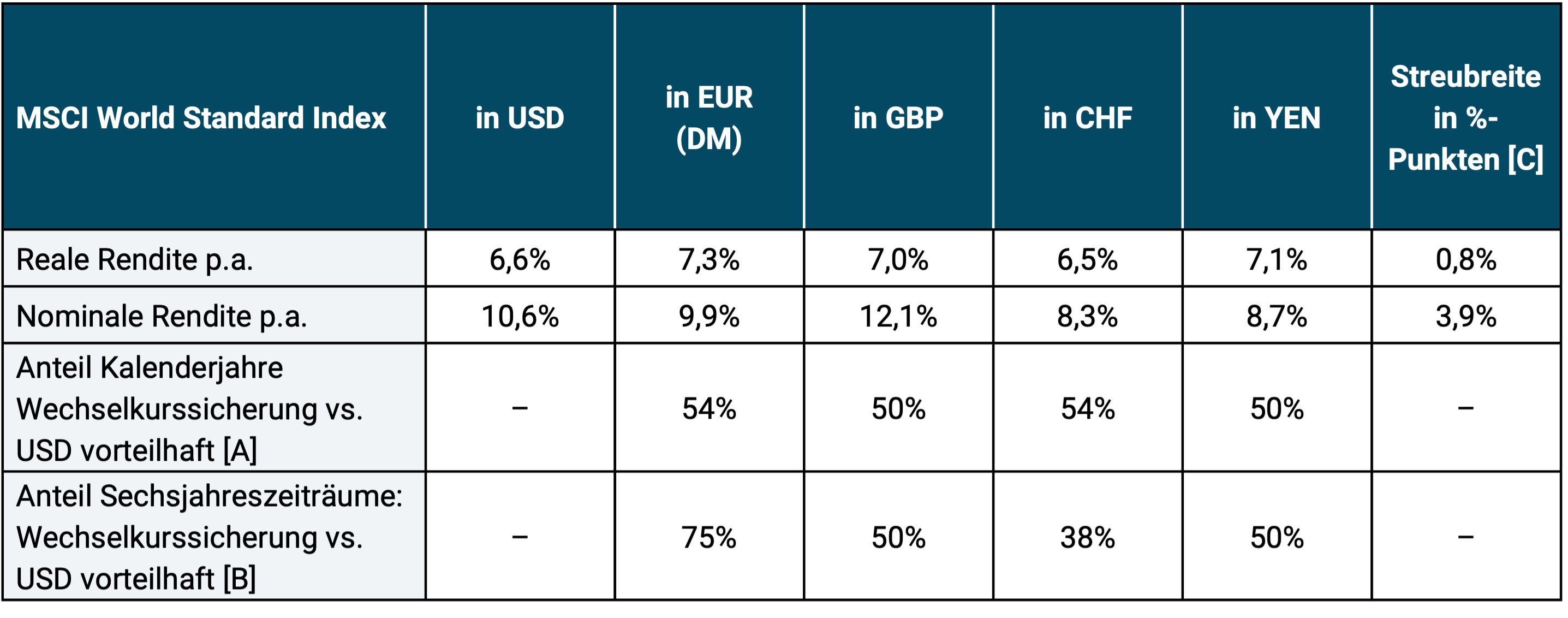
► [A] Percentage of calendar years in which exchange rate hedging against the USD would have been advantageous in terms of returns from the perspective of an investor with the functional currency specified in the respective column (Euro, GBP, CHF, Yen) (based on real returns, without taking into account costs in general, hedging costs in particular and taxes). ► [B] Analogous to (A) but based on non-overlapping six-year periods. The total period of 48 years was divided into 8 six-year periods. ► [C] Distance in percentage points between the highest and lowest values. It turns out that the spread of real returns is much narrower than that of nominal returns.
Due to the often large differences in nominal returns in different currencies, some investors believe that hedging an internationally diversified stock portfolio can reliably achieve higher returns in the future than without hedging. They assume that this means you can reliably “transfer” the higher nominal returns (or lower risk) in one currency into your own currency.
These investors make three related errors in reasoning. First, they look at the larger differences in nominal returns rather than the smaller, truly relevant differences in real returns.
Secondly, they miss the point made above that hedging in a globally diversified equity portfolio against the USD and or a limited number of hard currencies is in fact pseudo-hedging because the actual Exchange rate risks in the portfolio cannot be hedged - see our comments above. Instead, in reality, in addition to a stock investment, a separate exchange rate speculation. From the consolidated return or risk effect on the investor's portfolio - measured in their functional currency - one can actually only draw incorrect conclusions from such a hedge ex post.
Third, investors extrapolate unsystematic, random historical differences between global nominal stock market returns in different currencies into the future). This approach is just as mistaken as believing that one can draw sufficiently reliable conclusions about this size in the future from the historical excess or under-return of an individual stock. The bottom two lines in Table 1 indicate that in the short and medium term, long-term appreciation and devaluation trends do not even historically reveal a clear basis for hedging benefits.
There is a very broad consensus in the academic literature that exchange rate hedging in a globally diversified stock portfolio does not produce a systematic, i.e. sufficiently reliable, advantage (see some examples in the box at the end of this blog post). This is probably the reason why there are only a few funds with currency hedging when it comes to internationally or globally investing stock ETFs and actively managed stock funds.
(g) The different relevance of exchange rate hedging in the equity and bond parts of an overall portfolio
We have now seen that exchange rate hedging, and in particular hedging the USD exchange rate, makes no sense in a globally diversified equity portfolio. Let us now come to the question of exchange rate risk for bonds, insofar as they are intended to represent the “risk-free” (low-risk) part of the portfolio, i.e. the part of the portfolio that serves as a stability anchor in the world portfolio concept. For the purposes of this newsletter, the stability anchor is defined as a portfolio portion made up of bonds with a high credit rating (the first four rating levels of around 25) and a short to medium term in the investor's functional currency. In terms of volatility and repayment risk, they represent the lowest risk investments available - riskier than anything else, including bank balances and real estate. The volatility of such bonds is far lower than that of stocks. (Bank deposits within the state deposit insurance also fall into the low-risk investment category if the state guarantor has a correspondingly high/good rating.)
The MSCI World stock index had calendar year return volatility of approximately 20% from 1970 to 2022; German medium-term government bonds, however, only account for a quarter of this (around 5%) and German money market investments only a tenth (around 2%). The (nominal) maximum drawdown showed similar conditions (all figures in euros). In other words, high-quality bonds are dramatically less volatile than stocks based on common risk metrics.
If one were to introduce exchange rate risk into this low-risk asset class, e.g. B. by buying short- or medium-term foreign currency bonds of high quality (high credit rating) without a currency hedge, the relatively high volatility of the exchange rates (approx. 11% for the annual exchange rate fluctuations for common currency pairs, significantly more for emerging market currencies) would literally flood and destroy the fundamental low-risk character of this asset class. This would mean that the asset class would lose the core function for which we value it, namely that of a safety anchor in a portfolio that consists of a risky and a “risk-free” part.
It is therefore important to avoid exchange rate risk relative to the functional currency with higher quality bonds. If foreign currency bonds are included in such a portfolio part, their exchange rate risk should be hedged. Fortunately, currency hedging is much easier with bond funds or bond ETFs and global diversification is less important than with stocks. The ETF product landscape here is quite diverse.
Low-quality bonds such as German SME bonds, emerging market government bonds, other high-yield bonds and generally bonds with a remaining term of more than five years are not suitable for the stability anchor function anyway. Due to their weak credit rating or high duration risk, these bonds are so risky that they must be assigned to the risk-oriented part of the portfolio. Whether currency hedging is advantageous for you based on costs is likely to be a case-by-case decision.
(h) In which asset classes exchange rate hedging makes sense and in which it does not
In Table 2 we summarize for which asset classes and assets exchange rate hedging typically makes sense and for which it typically does not. Table 2 assumes the perspective of an investor in the Eurozone, i.e. an investor with the functional currency Euro, but the logic in Table 2 can easily be applied to e.g. B. transfer the perspective of a Swiss investor with the functional currency CHF.
Table 2: When does USD-Euro exchange rate hedging make rational sense from the perspective of an investor in the Eurozone and when does it not?

For high-yield bonds, e.g. B. Sub-investment grade corporate bonds (ratings worse than BBB–) or emerging market government bonds in USD or local currency, there is no clear, universal answer as to the usefulness of exchange rate hedging. The investor's specific preferences and expectations play a role here and what function the investment should play in the overall portfolio. In any case, the volatility of these interest-bearing investments, measured in euros, is likely to be higher in most years if they are not exchange rate hedged.
(i) A devaluing home currency has advantages and disadvantages at the same time
All other things being equal, the devaluation of a household's own currency (the functional currency) has a positive return effect - calculated in the investor's functional currency. From this perspective, every Eurozone investor should be happy about a depreciating "weak euro" and fear a strong euro, despite the fact that investment YouTubers often complain about the supposedly "chronically weak euro" on the Internet (there is certainly no data to back up this false statement about the euro's exchange rate developments since its birth in early 1999).
But the appreciation of the euro (and the devaluation of the dollar) also has a positive effect for households in the euro zone: the purchasing power of the investor household for imported goods and trips abroad tends to increase, i.e. h. the cost of living of the household decreases, other things being equal.
If a given exchange rate change has exactly the opposite effect on the return on financial investments and the current living costs of a household, one can speak of a natural hedge. This argument also tends to speak against exchange rate hedging in the equity part of the portfolio.
Conclusion
Currency-hedged global equity ETFs are typically rejected from a rational, passive investor's perspective given their higher costs and lack of return and risk benefits.
Hedging the USD exchange rate or the individual currencies to which the companies included in the index are “assigned” alone would ultimately be a pointless “hedge” in a globally diversified stock portfolio and, strictly speaking, represents a separate exchange rate speculation that distorts and can negatively influence the basic character of a stock investment.
A Fund's reporting currency (the Fund Currency) has nothing to do with real exchange rate risk.
In the case of bonds or bond funds that serve as a security anchor in the portfolio, exchange rate risk should be strictly avoided, otherwise they will partially lose their risk-reducing function.
An appreciation of an investor's home currency, which has adverse return effects on his financial portfolio, leads to an increase in his purchasing power for imported goods and when traveling abroad, so it is a natural hedge.
literature
Chang, Kelly (2009): “Currency Hedging: A Free Lunch?” (April 2009). Internet reference: here.
Dimson, Elroy / Paul Marsh / Mike Staunton (2006): “ABN AMRO Global Investment Returns Yearbook 2006;” ABN AMRO; Amsterdam 2006.
Jan Annaert, Jan et al. (2016): “Foreign Exchange Markets and Currency Speculation: Historical Perspectives”; In: “Financial Market History – Reflections on the past for investors today”; CFA Institute Research Foundation; Edited by David Chambers and Elroy Dimson; Dec. 2016.
Phillips, Mary (2015): “Currency Hedging”; Dimensional Fund Advisors; Strategy in Practice; May 2015. Unpublished manuscript.